Asbestos Exposure in the Workplace
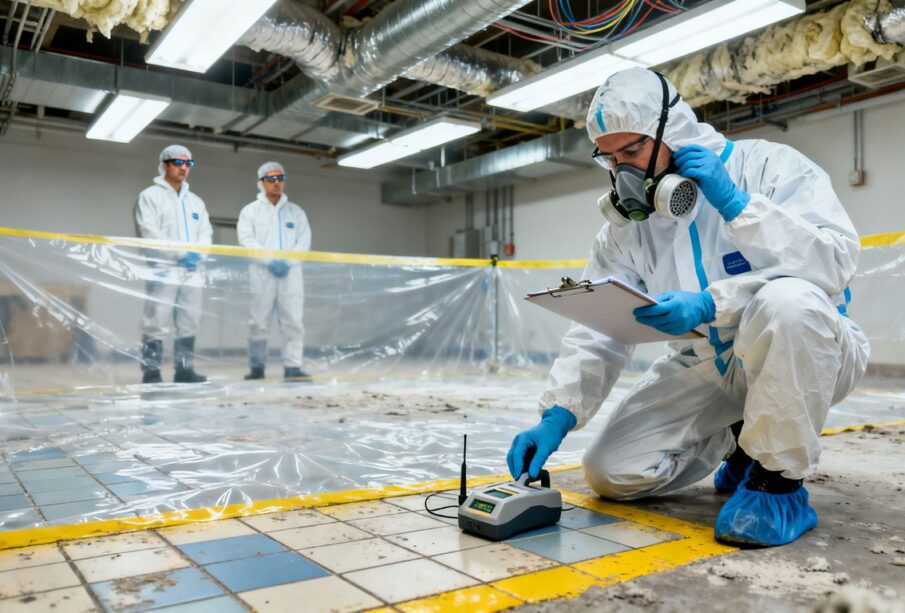
Older office buildings can hide asbestos in materials that appear ordinary, particularly when renovations disturb walls, ceilings, floors, mechanical systems, or fireproofing. Employers do not need to identify every hazard personally, but they do need a reliable process for finding hazards, assigning competent professionals, and protecting people before work begins. The following framework explains practical employer asbestos responsibilities for renovation projects in the United States.
Understand when asbestos may be present
Asbestos risk begins with uncertainty. A clean-looking office can contain asbestos in concealed or layered materials, and a recent remodel does not necessarily mean every older material was removed. Before approving demolition or construction, the employer should understand the building’s age, alterations, occupancy history, and current condition.
Why building age and renovation history matter
Asbestos was used widely in many construction products for decades because of its durability and resistance to heat. The age of a building is therefore a useful warning sign, but it is not a substitute for a professional inspection. Renovation records matter as well: one project may have removed ceiling tile while leaving asbestos-containing insulation around pipes or behind wall assemblies.
A building with several generations of work can contain a patchwork of materials and incomplete records. Even a small repair may expose hidden layers that were not relevant to earlier projects. The employer should treat historical information as an aid to planning, not as proof that a material is safe to disturb.
Common asbestos-containing materials in office spaces
Office hazards may occur in floor tile and mastic, resilient sheet flooring, textured finishes, ceiling materials, pipe and duct insulation, fireproofing, roofing products, and joint compounds. Materials can also be concealed above suspended ceilings, inside service chases, or around boilers and other mechanical equipment. Their appearance alone rarely provides a dependable answer.
The practical question is not whether a material looks old. It is whether renovation activities could damage, cut, sand, drill, scrape, remove, or otherwise disturb it. A survey should consider both visible materials and areas that workers will access as the project unfolds.
How building records and prior surveys inform planning
Drawings, specifications, maintenance files, abatement reports, and prior surveys can reveal where materials were installed and which areas were previously addressed. They may also identify restrictions, inaccessible spaces, or assumptions made by an earlier consultant. The employer should compare those records with current plans instead of placing unqualified reliance on an old report.
A useful file connects each known material to its location, condition, survey date, and planned treatment. The common asbestos-containing materials identified in general guidance can help a facilities team prepare questions, but professional evaluation remains necessary for the specific building.
When to presume materials contain asbestos
If material cannot be confidently identified before disturbance, the employer should ask the inspector or project professional whether it must be presumed to contain asbestos. Presumption is a protective planning choice: work is delayed or controlled until the material is characterized, rather than relying on a guess made at the job site.
That approach is especially valuable when records are missing, surfaces are layered, or sampling would be unsafe or impractical. The presumption should be written into the work documents so that contractors, supervisors, and occupants receive the same direction.
Arrange a qualified asbestos inspection
An inspection should be commissioned early enough to influence design, scheduling, and contractor selection. It should not be treated as a last-minute formality after demolition plans are complete. A qualified professional can help determine what must be sampled, what remains inaccessible, and what controls may be needed.
Reference Links
- Lanier Law Group
- Mesothelioma Guide
- UCLA Health
- Mesotheliomahub.com
- Weitz and Luxenberg Injury Lawyers
- MD Anderson Cancer Center
- Mesothelioma.com
- Mesothelioma Lawyer Center
- Gori Personal Injury Law
- OSHA.Gov
- Torhoerman Law
- Mesothelioma Help
- Mesotheliomahope.com
Selecting a competent asbestos inspector
The employer should verify the inspector’s education, field experience, applicable state credentials, and independence from the work contractor where local rules or project conditions call for separation. The inspector should understand commercial buildings and be able to work from architectural and mechanical plans. References and clear reporting practices are useful indicators of competence.
The employer should also confirm who will analyze samples and whether the laboratory is appropriately accredited for the required work. Credentials do not remove the need to define the assignment clearly, but they establish a sound starting point.
Defining the scope of the inspection
The scope should follow the renovation drawings and likely disturbance points, including demolition zones, penetrations, utility routes, ceiling plenums, floor transitions, and equipment rooms. It should state whether the inspection is a broad building survey, a renovation-focused survey, or an examination of selected materials. Areas that cannot be inspected should be listed rather than silently omitted.
The employer should provide the inspector with current plans and a description of the work. If the design changes, the scope may need to be revisited before workers enter the newly affected area.
Sampling materials before disturbance
Sampling should occur before materials are cut, removed, or damaged. A trained inspector selects representative samples and sends them to an appropriate laboratory; untrained employees should never collect samples as a shortcut. Sampling must account for different layers, colors, textures, and locations because a single result may not characterize an entire system.
The sequence is easier to manage when the project team understands why sampling belongs before demolition. A typical pre-disturbance process includes:
- Reviewing drawings, renovation plans, and building history.
- Identifying homogeneous materials that may be affected by the work.
- Collecting representative samples using controlled procedures.
- Recording sample locations, laboratory results, and unsampled areas.
Those records give the designer and contractor something concrete to use when preparing the work plan. They also make it easier to explain why a particular area is restricted or why additional investigation is required.
Interpreting survey results and limitations
A survey report should be read for its findings and its boundaries. Positive results identify asbestos-containing materials within the sampled scope, while negative results do not automatically clear visually different, inaccessible, or unsampled materials. The report should also describe material condition and the activities that could disturb it.
The employer should ask questions when the report uses broad language, omits concealed spaces, or predates substantial building changes. A clear limitation is useful; an unexplained gap can become a hazard during construction.
Meet applicable legal and regulatory duties
Renovation duties depend on the work, the material, the employer’s role, and the jurisdiction. Federal requirements may apply alongside state and local rules, and construction or demolition activities can be treated differently from routine building operations. Employers should obtain current advice from qualified safety and regulatory professionals rather than treating a general article as legal advice.
OSHA requirements for asbestos exposure
OSHA standards address occupational exposure to asbestos and require employers to evaluate hazards and protect workers within the applicable standard. Depending on the work, obligations can include exposure assessment, regulated areas, methods of compliance, training, protective clothing, respiratory protection, housekeeping, medical surveillance, and recordkeeping.
The employer should identify which OSHA standard and work classification apply before work starts. OSHA’s workplace asbestos duties provide useful general context, but the project team must still review the requirements that match the actual activities and exposure conditions.
EPA rules for renovation and demolition activities
EPA requirements may apply to renovation and demolition, including notification, work practices, and waste handling under the relevant federal program. Applicability can turn on factors such as building type, project size, material classification, and the nature of the activity. The employer should determine these points before issuing a notice to proceed.
A contractor’s involvement does not automatically transfer every duty away from the building owner or employer. Contracts should assign responsibilities clearly, while the employer verifies that required notifications, procedures, and disposal documentation are being addressed.
State and local requirements that may add protections
States and local jurisdictions can impose licensing, notification, training, project, or disposal requirements that differ from federal baselines. Some rules apply to building owners, facility managers, employers, or contractors in distinct ways. A project team working across locations should not assume that a process accepted in one jurisdiction will satisfy another.
For example, California’s occupational asbestos rule has its own scope, definitions, and relationships to construction and ship-repair provisions, as described in the California asbestos regulation. The applicable authority should be confirmed for the project location and work category.
How employer asbestos responsibilities vary by project scope
A minor maintenance task, a wall opening, a major renovation, and a full demolition can create different regulatory questions. The employer should examine who controls the workplace, who directs the work, who may be exposed, and whether the activity can release fibers. A project’s label—such as “repair” or “remodel”—does not by itself determine the obligations.
Written role assignments help prevent gaps. The owner, employer, general contractor, designer, and asbestos professional should know who controls access, approves changes, communicates hazards, and stops work when conditions differ from the plan.
Plan renovation work around identified hazards
Survey results should change the renovation plan, not merely sit in a project folder. The design team may need to adjust demolition boundaries, work sequences, materials, occupied areas, or budget assumptions. Early decisions are usually safer and less disruptive than emergency abatement after a material is damaged.
Creating an asbestos management and work plan
The plan should identify known or presumed materials, locations, conditions, responsible parties, work methods, containment arrangements, waste procedures, emergency contacts, and clearance criteria where applicable. It should be specific enough for supervisors and workers to use at the job site. A generic safety attachment rarely answers the questions that arise in a particular office.
The plan should also explain how changes will be reviewed. Drawings, schedules, and subcontractor methods can shift during construction, so the employer needs a process for comparing revisions against the asbestos information before work proceeds.
Determining whether to remove, encapsulate, or avoid materials
Removal may be appropriate when materials must be disturbed or would interfere with future maintenance. Encapsulation or enclosure may be considered when the material can remain safely in place under a suitable management program. Avoidance is often the simplest option when the design can be changed without compromising the building.
The decision should account for material condition, future access, planned maintenance, exposure potential, cost, and regulatory requirements. It should be made by qualified professionals and recorded with the reason for the selected approach.
Coordinating employers, contractors, and building occupants
Coordination is essential when several employers share a building. The employer should provide relevant hazard information to contractors, establish communication channels, and make sure subcontractors receive the same work boundaries and stop-work instructions. Occupants need practical information about affected areas, schedules, access restrictions, and whom to contact with concerns.
The plan should fit the building’s operating realities. Security staff, cleaning teams, facilities personnel, and information-technology workers may enter renovation zones unless access controls and briefings address their roles directly.
Establishing stop-work procedures for unexpected materials
Every project should have a simple response for suspect material discovered after work begins. Workers should stop the activity, leave the immediate area as directed, prevent unnecessary access, and notify the designated supervisor. The material should not be swept, handled, or sampled by unqualified personnel.
The employer should then arrange evaluation by an appropriate professional and revise the work plan if needed. Clear stop-work authority is a sign of sound planning, not an admission that the survey failed.
Control exposure during asbestos-related work
When asbestos-related work is required, the employer must ensure that the selected controls match the task and applicable rules. The work area, tools, personnel, waste route, and cleanup method should be considered together. A safe-looking setup can still fail if contaminated materials travel through ordinary building traffic.
Using licensed or appropriately trained asbestos contractors
The employer should verify that contractors and workers hold the licenses, certifications, training, and experience required by the jurisdiction and task. Qualifications should be checked before mobilization, not after a problem occurs. The contract should require compliance with the approved work plan and prompt reporting of changing conditions.
The employer also should confirm who supervises the work and who has authority to halt it. Competent contractor selection is one part of oversight; it does not eliminate the employer’s responsibility to coordinate workplace protections.
Setting regulated areas and restricting access
Regulated areas should be established wherever the applicable standard requires them or where work conditions could expose people to asbestos. Boundaries, signs, barriers, and entry procedures should be understandable to workers and occupants. Access should be limited to authorized, properly protected personnel.
Routes for workers, tools, materials, and waste should be planned before containment is built. This reduces the chance that people will cross from a controlled area into shared corridors, elevators, or occupied offices without proper decontamination.
Applying engineering controls and safe work practices
Controls can include enclosure or containment, local exhaust ventilation, wet methods where appropriate, careful removal techniques, HEPA-filtered equipment, controlled waste handling, and effective decontamination. The selected methods must reflect the material and task; a control suitable for one activity may be inadequate for another. Dry disturbance and careless cleanup should be prohibited.
Supervisors should observe the work and correct deviations immediately. Housekeeping, equipment inspection, and containment checks are ongoing duties rather than tasks reserved for the final cleanup.
Providing personal protective equipment and respiratory protection
Personal protective equipment should be selected for the expected exposure and used with the required training, fit testing, medical evaluation, and maintenance. Respiratory protection is part of a complete program, not a substitute for engineering and work-practice controls. Protective clothing and decontamination procedures should prevent fibers from being carried into clean areas.
The employer should make sure workers understand limitations, donning and removal sequences, and what to do if equipment fails. Records of training, fit testing, and program administration should be retained as required.
Managing air monitoring and clearance testing
Air monitoring can help assess exposures, verify controls, and support decisions about reoccupancy when required by the work plan or regulation. Sampling strategies should be established by qualified professionals and interpreted in context. Clearance testing, where applicable, should occur after cleanup and before the area is released for normal use.
A result is only meaningful when the sampling location, timing, method, and laboratory process are documented. If results do not support release, the employer should keep the area controlled until additional cleaning and evaluation are complete.
Protect employees, contractors, and building occupants
Protection extends beyond the people performing abatement. Office employees, visitors, delivery staff, and other contractors can be exposed if they enter an uncontrolled area or receive incomplete information. The employer should treat communication and building operations as part of the exposure-control plan.
Informing workers about asbestos hazards and procedures
Workers should receive information appropriate to their duties, including where asbestos may be located, how it can be disturbed, which areas are restricted, and how to report a concern. Employees who do not perform asbestos work still need enough information to avoid unsafe drilling, maintenance, or cleanup. Training should be understandable and documented.
Contractors should receive site-specific information before beginning work. A general orientation cannot replace instructions about the building’s actual materials, boundaries, and emergency contacts.
Scheduling work to reduce exposure to occupants
The employer should consider performing disruptive work during unoccupied periods, separating renovation areas from active offices, and coordinating noisy or dusty tasks with building operations. Scheduling alone does not make hazardous work safe, but it can reduce the number of people who could be affected by an unexpected event.
Occupants should receive timely notices that explain what areas will be unavailable and what alternate routes or facilities are available. The notice should avoid reassuring claims that have not been supported by inspection or monitoring.
Preventing contamination of shared spaces and ventilation systems
Containment, pressure control where appropriate, sealed waste routes, and protection of HVAC systems can limit migration from the work area. The project team should determine whether ventilation must be isolated, modified, or monitored, while maintaining safe conditions for the rest of the building. Doors, penetrations, and service openings deserve particular attention.
Cleaning and inspection should address adjacent spaces, not only the immediate work zone. Shared elevators, corridors, restrooms, and loading areas can become pathways for contamination if the movement plan is poorly controlled.
Handling suspected exposure or accidental disturbance
If accidental disturbance occurs, the employer should follow the written emergency procedure, restrict access, avoid disturbing settled dust, and contact the designated asbestos professional. The event should be documented promptly, including the material, location, time, people involved, actions taken, and any monitoring or medical advice obtained.
Workers should be told how to report symptoms or concerns without fear of retaliation. The response should focus first on controlling the area and obtaining competent evaluation, rather than assigning blame before the facts are known.
Providing medical surveillance when required
Certain asbestos work and exposure conditions can trigger medical surveillance obligations under applicable OSHA requirements or other rules. The employer should have a qualified safety or occupational-health professional determine whether surveillance applies and what records must be maintained.
Medical information should be handled confidentially and separately from ordinary project files. Workers should receive the notices and evaluations required for their circumstances, with enough time to participate before covered work begins.
Document compliance and maintain the building safely
A safe renovation ends with more than a final invoice. The employer should preserve the information future maintenance workers will need and keep remaining asbestos from becoming an unknown hazard. Good documentation supports regulatory compliance, continuity, and safer decisions when the next project is planned.
Keeping inspection, sampling, and renovation records
The building file should include surveys, sample results, laboratory information, drawings, photographs, work plans, notifications, permits, waste records, air-monitoring data, clearance reports, and completion documentation as applicable. Records should identify dates, locations, responsible professionals, and limitations. Electronic storage is useful when files remain searchable and protected from unauthorized alteration.
The employer should compare final construction conditions with the original plan. If materials were removed, enclosed, or left in place, the record should say so plainly.
Maintaining an asbestos operations and maintenance program
An operations and maintenance program provides procedures for managing asbestos that remains in the building. It can cover periodic inspections, labeling or location information, response to damage, housekeeping, maintenance work, employee awareness, contractor communication, and record updates. The program should be scaled to the building and reviewed by someone with appropriate knowledge.
The central goal is to prevent routine work from disturbing materials unknowingly. A program that is rarely consulted should be revised so facilities staff can use it during ordinary repairs and service calls.
Tracking contractor qualifications and training
The employer should retain evidence of contractor licenses, worker training, supervisor qualifications, respiratory-protection participation, and other credentials required for the work. Expiration dates and project-specific requirements should be tracked before access is granted. This creates a practical check against relying on an outdated certificate or verbal assurance.
Training records should be matched to the tasks assigned. Workers performing regulated activities need different preparation from office staff who only require awareness of locations and reporting procedures.
Communicating remaining asbestos hazards to future workers
Materials left in place should be identified in building records and communicated to future owners, managers, maintenance teams, and contractors. Information should be available before new work begins, not discovered after a wall or ceiling has been opened. Clear location descriptions are more useful than a vague statement that asbestos exists somewhere in the building.
The employer should also explain how workers can obtain the current survey and report damaged or uncertain materials. Consistent communication protects people who were not involved in the original renovation.
Reviewing the program after renovation or workplace changes
The employer should review the asbestos program after construction, tenant changes, mechanical upgrades, water damage, or other events that may alter building conditions. New penetrations and repairs can create hazards even when the original renovation was well controlled. A post-project review should identify lessons, unresolved materials, and needed updates.
Periodic review keeps the building file aligned with reality. It also gives management a chance to confirm that responsibilities remain assigned as personnel, contractors, and occupancy arrangements change.
Renovating an older office safely requires disciplined preparation, qualified evaluation, and consistent communication. Employers that identify uncertainty early can choose safer designs, set appropriate controls, and preserve information for future work. The strongest approach treats asbestos management as an ongoing building responsibility rather than a single inspection performed before demolition.